How to Test Silver at Home: Spotting Real Silver Finds
You just dug a tarnished spoon or a heavy ring and need to know what you have. Here are practical ways to test silver at your kitchen table without damage.
Digging an ornate spoon or an engraved pendant out of the mud is an unforgettable thrill, but once you rinse off the clotted dirt at your kitchen sink, the big question immediately arises: is it real silver, or did you spend twenty minutes excavating a heavily plated brass trinket? Learning how to test silver at home is an essential skill for anyone who swings a detector, browses flea markets, or sorts through family estate boxes. I learned this the hard way during my second year of detecting when I dug a heavy, tarnished serving ladle from an old farmhouse dump. Thinking it was cheap nickel alloy, I tossed it into my scrap bucket. Months later, a curious friend examined the handle under magnification, cleaned off the grease, and identified a crisp 19th-century hallmark that proved it was solid sterling. That near-miss taught me never to guess when simple tests can give you the truth in minutes.
Reading Silver Hallmarks Under Magnification
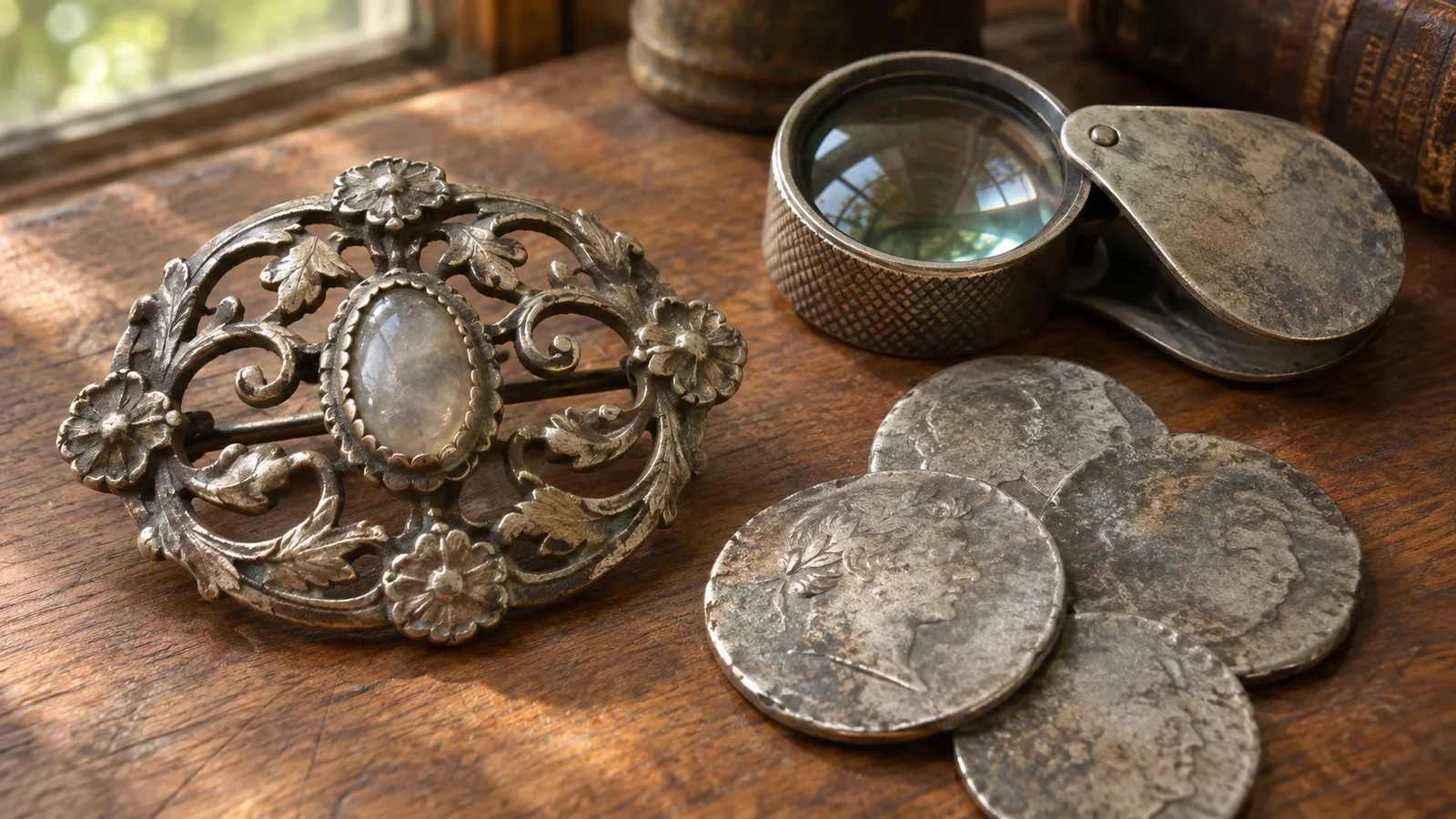
The quickest and least invasive test requires nothing more than a bright desk lamp and a standard 10x jeweler's loupe. In most countries, silver objects have been stamped by law for hundreds of years to guarantee metal purity.
When examining British items, silver hallmarks offer an exact pedigree. A genuine piece of British sterling carries a series of small punched marks: the standard mark (a walking lion, or lion passant, denoting 92.5 percent purity), an assay town mark (such as an anchor for Birmingham or a leopard head for London), a date letter showing the year of manufacture, and a maker punch. American items manufactured after the mid-19th century usually skip the complex heraldry and stamp words directly into the metal, such as 'STERLING', '925', or 'COIN' (which denotes ninety percent purity common in 19th-century American flatware).
Be cautious with deceptive plating stamps. If you spot marks like 'EPNS' (Electroplated Nickel Silver), 'EPBM' (Electroplated Britannia Metal), 'EPC' (Electroplated Copper), or 'Quadruple Plate', the item is composed of a base metal core coated in a thin wash of silver. These pieces often show base brass or grey zinc peeking through worn contact points.
The Ice Cube Thermal Test
Silver possesses the highest thermal conductivity of any common metal. It conducts heat and cold far faster than copper, brass, pewter, or nickel. This physical property allows you to perform a reliable test using an ordinary ice cube straight from your freezer.
Place your mystery item flat on a dry paper towel. Take an ice cube and place it directly onto the metal surface. Then place a second ice cube on a standard brass or stainless steel coin next to it as a control. If your find is real silver, the ice cube will begin melting immediately, as if placed on a warm pan. The cold transfers through the silver so rapidly that if you touch the underside with your bare finger, you will feel it turn icy cold within two or three seconds. Base metals and plated items melt the ice at a noticeably slower rate.
The Ping Acoustic Test for Coins and Rounds
Precious metals vibrate with a high-frequency resonance that base metals cannot duplicate. When struck gently, real silver produces a long, clear, musical ringing sound that lingers in the air for two to three seconds. Base metals like copper-nickel clad or brass produce a flat, hollow 'thud' that dies almost instantly.
To perform the test safely without denting a coin, balance the coin carefully on the tip of your index finger. Take a wooden pencil or a known silver coin and tap the edge of the mystery piece very lightly. Listen for that lingering, bell-like sustain. Smartphone audio apps can also measure this resonance against reference frequency charts.
The Magnetic Slide Test
Silver is diamagnetic, meaning it does not adhere to magnets. If you touch a strong neodymium earth magnet to your dug find and it snaps tight, you are holding iron, steel, or heavily nickel-doped pot metal. If it does not stick, that is a positive first step, though copper and brass are also non-magnetic.
A more refined approach is the magnetic slide. If you have a flat silver bar, a large silver medallion, or a thick silver round, tilt the item at a forty-five-degree angle and let a strong neodymium magnet slide down the face. As the magnet moves across the silver, the moving magnetic field induces miniature electrical eddy currents inside the silver. These currents create a counter-magnetic field that acts as an invisible brake. Instead of tumbling freely, the magnet will slide down the slope in slow motion without sticking. Plated lead or zinc will not produce that resistance.
Chemical Testing and What to Avoid
For unmarked jewelry or scrap items where visual checks leave doubt, acid testing kits using Schwerter's solution (nitric acid and potassium dichromate) provide chemical proof. A tiny drop applied to silver reacts to form silver chromate, turning blood-red for sterling and dark red for eighty percent silver. On base metals, the acid foams blue or green.
However, treat acid tests as a method of last resort. Acid eats metal and leaves an etched scar. Never apply testing acid to the face of a collectible coin or a delicate antique brooch. If you must test, place an imperceptible micro-notch on the inner edge of a thick ring shank or the underside of a broken spoon handle. Another popular myth is using household bleach; while bleach oxidizes silver black on contact, it pits and discolors precious relics permanently.
Cataloging Relics and Digital Simulators
Verifying mystery finds at home can take hours of patience and careful research. Sometimes after a muddy day in the field, it is refreshing to enjoy the hobby without scrubbing dirt off mystery metals. In the mobile simulator MetalHunter, you can explore varied settings from old villages to coastal beaches, where every recovered target comes with verified catalog information and realistic weights automatically. It provides a fun, relaxed way to experience the thrill of coin and relic hunting on days when your test kit is packed away.
Safety and Legal Boundaries for Found Objects
Whenever you test historical finds, keep ethical and legal boundaries in mind. In the United Kingdom, any discovered object that might qualify under the Treasure Act must be formally presented to the local Finds Liaison Officer or coroner within fourteen days. In the United States, always ensure your finds were gathered on private land with documented landowner permission, staying far away from protected archaeological monuments and state parks where artifact removal is prohibited.
Finally, remember that detecting fields can turn up dangerous objects alongside pleasant silver trinkets. If your coil ever encounters a heavy cylindrical iron object resembling an unexploded mortar round or rusty artillery fuse, never scrape it, shake it, or bring it home to test. Mark the site and dial 911 or 999 without delay.
| Test Method | Primary Tools Needed | Destructive Risk | Best Suited For |
|---|---|---|---|
| Hallmark Inspection | 10x Jeweler's Loupe | None | Jewelry, silverware, and vintage watches |
| Ice Cube Test | Ice cube and paper towel | None | Spoons, plates, bars, and large coins |
| Ping Resonance Test | Wooden pencil or wooden stick | None | Coins, rounds, and solid tokens |
| Neodymium Slide | Rare-earth neodymium magnet | None | Heavy bullion rounds, bars, and ingots |
| Acid Chemical Test | Schwerter's solution kit | High (leaves etched spot) | Unmarked scrap jewelry, broken silverware |
FAQ
Can a piece of silver have no hallmarks at all?
Yes, many early hand-poured pieces, custom artisan jewelry, or colonial-era coins lack official assay stamps. In those situations, non-destructive physical tests like specific gravity and thermal conductivity help determine metal content.
Why does my silver item look dark grey or golden in the dirt?
Soil minerals and sulfur react with silver over decades to form silver sulfide patinas ranging from light amber to deep charcoal. This protective oxidation layer does not mean the underlying metal is fake.
Does silver stick to a powerful magnet?
No, silver will never stick to a magnet. If your coin or piece of jewelry clings to a magnet, it is made of steel, nickel, or an iron-rich base alloy.
What is German silver or nickel silver?
Despite the confusing names, German silver and nickel silver contain zero percent real silver. They are base metal alloys composed of copper, nickel, and zinc, manufactured to imitate the lustrous appearance of genuine sterling.